Set Up Your Wallet
“Choose how you’d like to set up your KeepKey.”
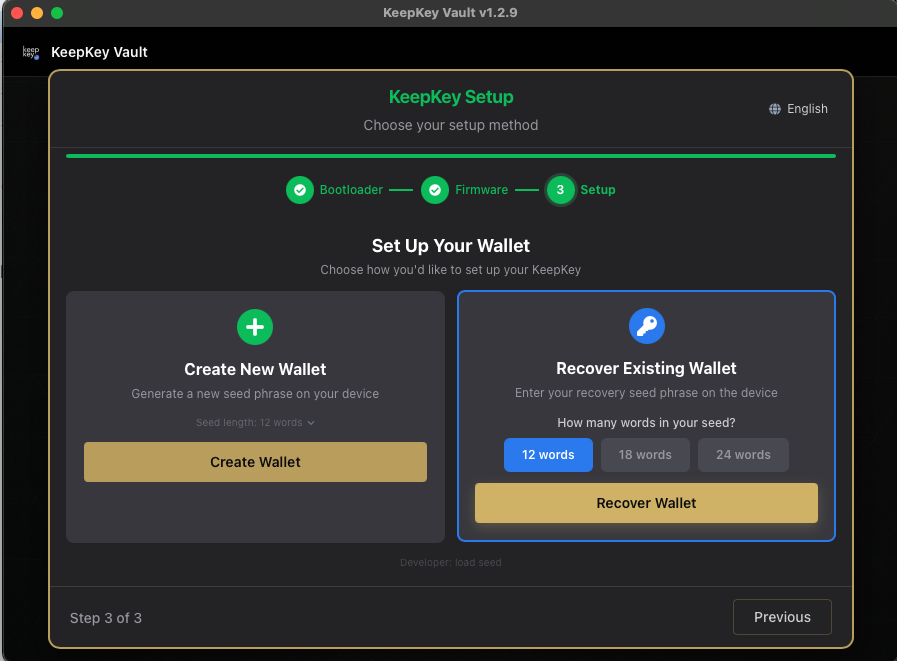
This is the fork in the road. Everything after it writes to the device.
Create New Wallet
“Generate a new seed phrase on your device.”
Pick this if the KeepKey is new to you and you do not already have a recovery phrase you intend to use.
The device generates the seed itself, on-device, and displays the words on its own screen. Your computer never sees them. Have pen and paper ready before you click — the words are shown once.
Recover Existing Wallet
“Enter your recovery seed phrase on the device.”
Pick this if you already have a 12, 18, or 24-word phrase — from an older KeepKey, or from another BIP39 wallet you’re migrating.
You’ll enter the words using scrambled cipher entry, not a text box. Choose the correct word count before you start: the How many words in your seed? selector must match your backup exactly. A 12-word phrase entered as a 24-word recovery will fail, and a mismatched count is the most common recovery problem people hit.
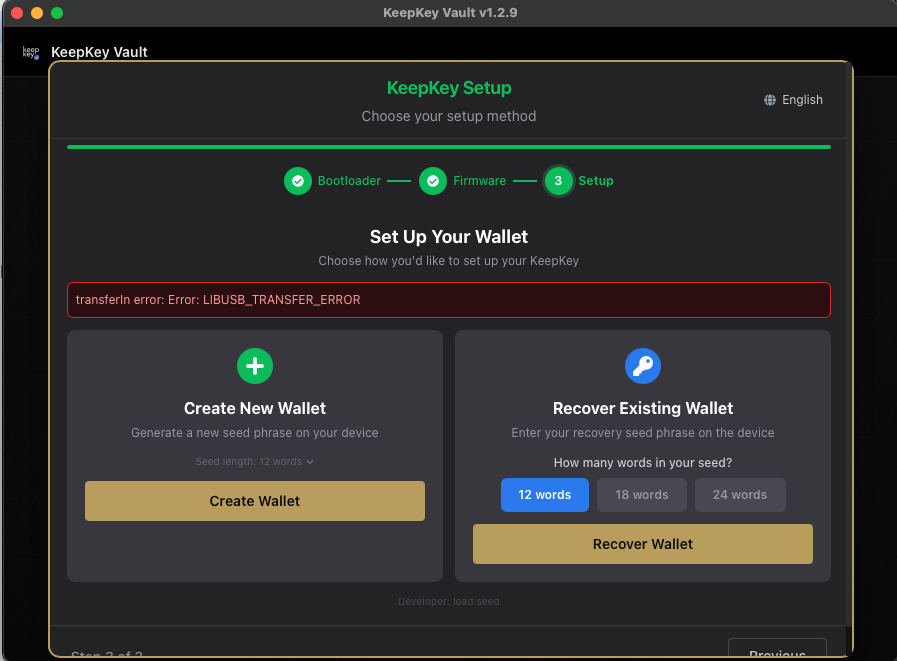
Seed length and entropy
Under Create New Wallet, expanding Seed length lets you pick 12, 18, or 24 words. The app notes:
“Added seed length does not improve overall wallet entropy.”
That statement surprises people, so here is the reasoning.
The seed lengths map to entropy like this:
| Words | Seed entropy |
|---|---|
| 12 | 128 bits |
| 18 | 192 bits |
| 24 | 256 bits |
But the keys derived from that seed live on secp256k1, the elliptic curve used by Bitcoin, Ethereum, and nearly every chain KeepKey supports. Against the best known generic attack on that curve (Pollard’s rho), a 256-bit key provides roughly 128 bits of security. That ceiling applies no matter how much entropy went into the seed above it.
So going from 12 words to 24 words takes you from 128 bits of seed entropy to 256 — sitting on top of keys that top out around 128 bits of practical security either way. You have doubled what you must transcribe and store correctly, and not moved the number that actually bounds an attacker.
For calibration: 128 bits is not a number that gets brute-forced. It is not “probably fine” — it is beyond the reach of any conceivable classical computing effort, by many orders of magnitude.
Where longer phrases genuinely do matter:
- Compatibility. If you’re recovering an existing 24-word phrase, you obviously need 24 words. This is about generating a new one.
- Policy. Some institutions or multi-party arrangements mandate 256-bit seeds. If that’s your situation, pick 24.
- Personal conviction. 24 words is fully supported and costs you nothing but a longer thing to write down. If you’d sleep better, pick it.
Where longer phrases actively hurt:
- Twice as many words to transcribe correctly, twice the chance of a backup error.
- Twice as many words to enter during a recovery, under stress.
- More surface to store, split, or engrave.
The honest summary: 12 words is the recommended default, 24 is available and safe, and the difference is not the security upgrade it looks like.
This choice does not affect a passphrase, which is separate from the seed and adds its own protection on a different axis entirely.
Before you click either button
- Be alone, out of camera view, away from windows and smart speakers.
- Paper and pen in hand if you’re creating.
- Your written backup in hand if you’re recovering.
- Do not walk away mid-flow — the device is waiting on you at several points.
Related
- Creating Your Wallet — the next screen
- Scrambled Recovery Entry
- Recovery Phrase
- All setup screens