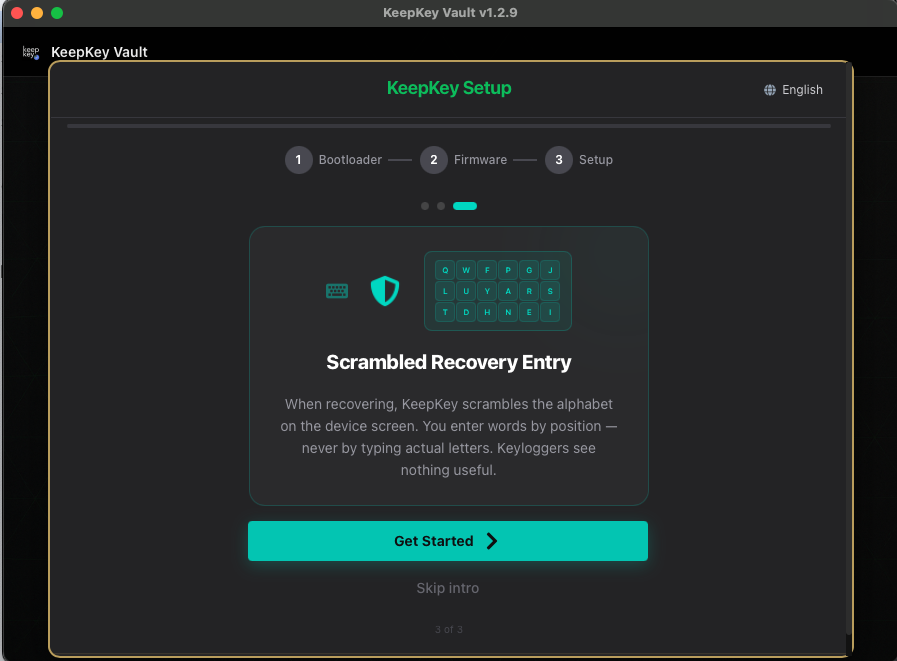
Scrambled Recovery Entry
“When recovering, KeepKey scrambles the alphabet on the device screen. You enter words by position — never by typing actual letters. Keyloggers see nothing useful.”
— card 3 of 3, shown before setup
What this screen is telling you
Recovery is the one moment your entire seed passes through a user interface. Every other wallet does this with a text box — which means, for those few minutes, your recovery phrase exists in plaintext on a general-purpose computer. That is where seeds get stolen.
KeepKey never puts the letters on your computer. It puts a shuffled alphabet on the device screen, and your computer only ever sees which square you clicked.
How the cipher input works
-
The device shows the alphabet in a random layout — for example:
Q W F P G J L U Y A R S T D H N E I O Z X C V B K M -
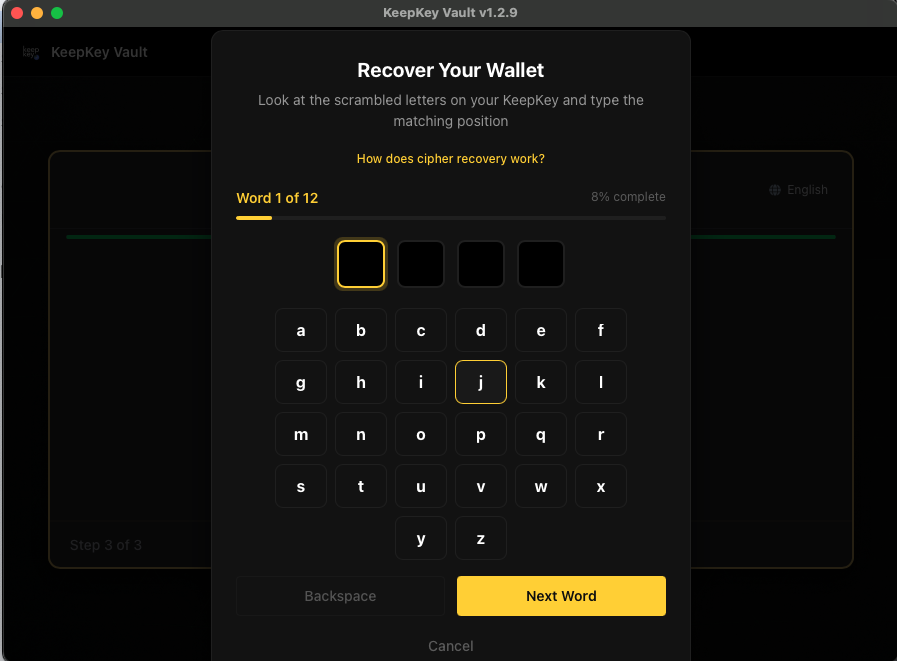
The desktop application shows a blank grid in the same arrangement. No letters.
-
For each letter of the current word, look at the device, find the letter, and click that position on the computer. To enter
F, find F on the device and click wherever it sits. -
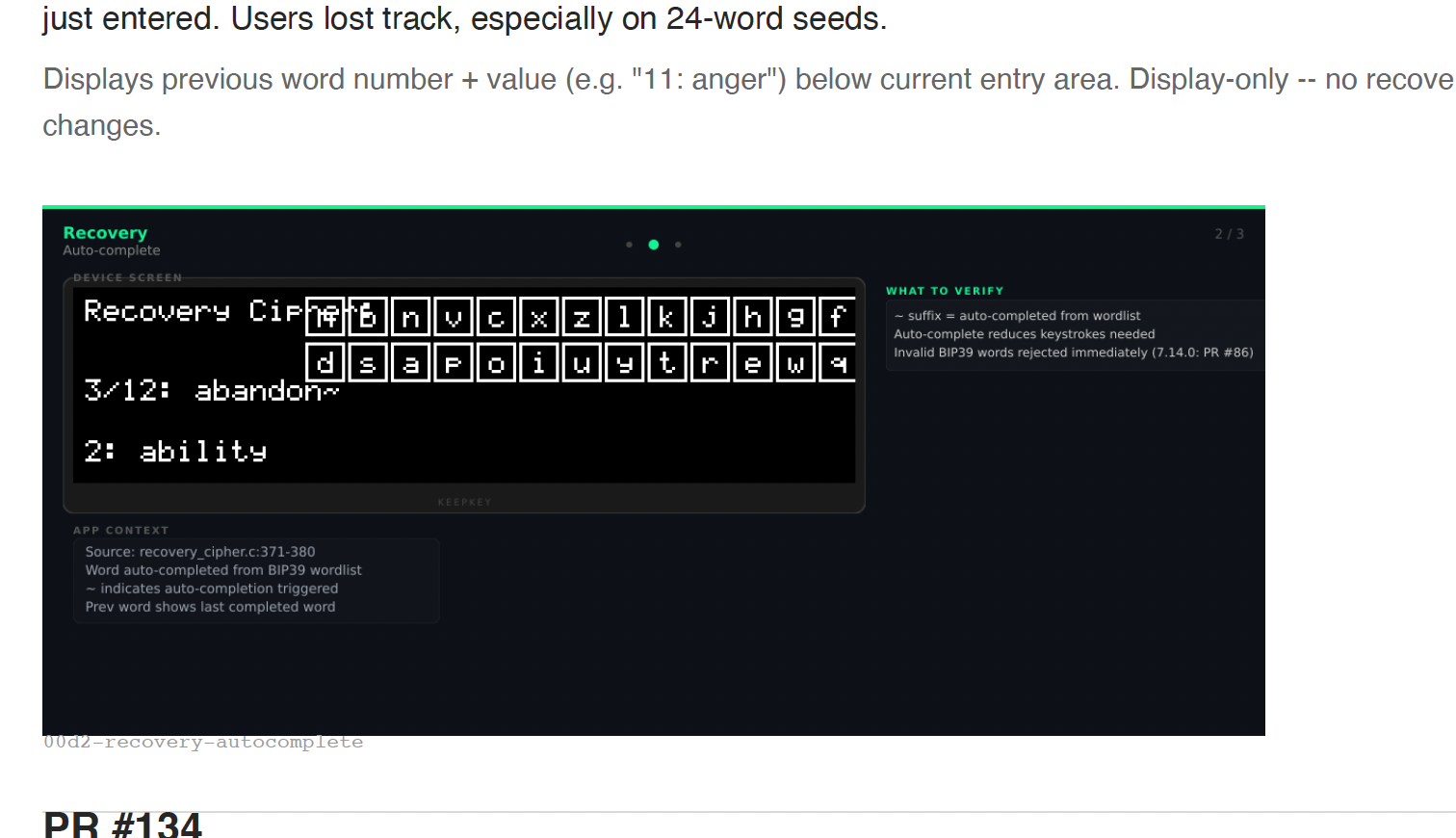
The device autocompletes each word from the BIP39 list once enough letters are in — you’ll see the word resolve on the device screen.
-
The alphabet reshuffles for the next word. The same position never means the same letter twice.
What attack this defeats
| Attack | What the attacker gets |
|---|---|
| Keylogger | Mouse clicks on a blank grid |
| Screen recorder | A video of blank squares being clicked |
| Clipboard sniffing | Nothing — you never copy or paste |
| Compromised desktop app | Positions, with a mapping it never receives |
| Shoulder surfing your monitor | Nothing — the letters are on the device, facing you |
The only way to read the phrase during recovery is to see the device screen at the same time. So: shield the device, not the monitor.
Rules while recovering
- Look at the device, not the computer. The device is the source of truth; the desktop grid is just a click surface.
- Be alone, and out of camera view. Webcams, security cameras, and windows all see the device screen.
- Enter words in order, exactly as written down.
- Pick the right word count first. A 12-word phrase entered as a 24-word recovery will not work — see Set Up Your Wallet.
If a word won’t take
The device only accepts words from the BIP39 English wordlist. If a word is rejected, check your backup for a transcription error — recieve/receive, flat/float, an ambiguous handwritten letter. Every BIP39 word is uniquely identified by its first four letters, which is often enough to disambiguate bad handwriting.